
Northern Israel
Israel’s North is a mosaic of natural wonders & beauty
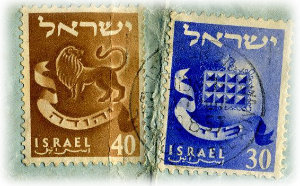
Letter Excerpts:
“Sunday morning we left the Kibbutz & began touring parts of the Galil, Israel’s bread basket the Valley of Jezreel, and finally Haifa & the huge industrial plants.
August 5, 1957 – Night
I spent the weekend at a hotel on the shores of Lake Kinneret. I saw the Kibbutz Dagania yesterday…Today we are going into Western Galilee…
August 11, 1957 – Night
“I’m sitting on a porch of a hotel at Metulah northern most point in Israel waiting for lunch.” “We are now on a tour of the Galil from yesterday until next Monday.”
“Yesterday we visited Hadera Nazareth Tiberias & certain Kibbutzim. We slept at a hotel on the shores of Lake Kinnert. Today we toured all of the north of the Galil & saw some of the holiest places of our religion. The tombs of Hillel & Shamai,”
“The Huleh Vallay is really a remarkable achievement of Israel. It was all swamp & now you see all green except when in between planting you see Black earth”
August 15, 1957 – Night
“Yesterday I returned from the Galil trip & a tour of Haifa to Jerusalem. Tomorrow morning I am leaving for a tour of the Haifa Bay Industrial Region and then Tel Aviv.”
August 20, 1957 – Night
“I am now in Naharia which is a resort & industrial city North of Haifa. It is typical Catskill Mountains in all respects except that industry is also present.”
“Last night was spent in another beautiful pool for night bathing with a group from a nearby Israeli army rest camp. Every soldier is required to take 2 weeks of rest at the seashore resort in nice tents on the beach at Government expense.”
August 22, 1957 – Night

Chamber of the Holocaust on Mt. Zion
Opposition leader, Menachem Begin leads the popular protests against Reparations
A mass protest in Israel against accepting Reparations (“Jewish blood money”) from Germany
The Beautiful North
There are many places to tour in the north of Israel, each place with its own special beauty. The places the author visited on his tour of the north included the Kinneret, Tiberias, Hulah Valley, Har Arbel, Metullah, Tzfat, Nazareth, Hadera, Emek yizrael Hadera, Haifa, Metullah, Naharia and many kibbutzim including Kibbutz Lavi. The scenery in the north is a must see. (see links below to view details of each location)
Tiberias is an Israeli city on the western shore of the Sea of Galilee. The city has a history of being a holy city (the Rambam, Rabbi Akiva, Rabbi Meir Baal HaNess, the Ramchal are among Jewish sages who are buried there).
In the 2nd–10th centuries, Tiberias was the largest Jewish city in the Galilee, and the political and religious hub of the Jews in the Land of Israel. “Hammat Tiberias”, which is now part of modern Tiberias, is known for its hot springs, believed to cure skin and other ailments, for some two thousand years.
Metula is Israel’s is in the northeast right next to the Lebanese border. In 1957 it also bordered Syria as the Golan Heights was in Syrian hands. On a clear day you can see not only Lebanon, but current Syria as well.
Nahariya is the northernmost coastal city in Israel approximately 5 miles south of the Lebanon Border.. Nahariya takes its name from the stream of Ga’aton (river is “nahar” in Hebrew), which bisects it. In 2019 it had a population of 58,096 During the Israel pre-state days, back in 1935, approximately 40 pioneers had settled in Nahariya. The first settlers lived in huts, but the settlement was rapidly developed and the residents engaged in agriculture. It became a development town in the 1950s after a ma’abara established nearby was integrated. The town hence became a home to many Jewish refugees from North Africa, the Middle East and Europe.
After economic and climatic problems the residents soon realized that agriculture was impractical and chose to focus on tourism and the food industry. Nahariya was then turned into a European-style resort town, taking advantage of the natural surroundings and beaches, as new inns were opened. Two prominent food manufacturers also set up shop: the “Strauss Company” and the prominent butcher shop “Soglowek”
One location in the north which wasn’t accessible in 1957 is the fascinating tourist attraction of Rosh Nanikra, which is located at the most north-western corner of Israel. It is the only point in the country where the sea meets the mountains, and boasts some amazing natural phenomena, such as the “grottos”, which are marine caves created from a series of subterranean tremors which cracked the rock. Rainwater flows through these cracks and the gushing sea waves created this unique natural phenomenon. The steepest cable cars in the world, built in 1968, serve tourists who wish to visit this site.
Bob & Elaine on the top of Mt. Arbel, overlooking Lake Kinneret, during their trip to Northern Israel.
Har Arbel today. The white circle indicates the exact spot where Bob & Elaine sat in 1957
The Ohalo hotel 1957, on the shores of the Kinneret, where my parents stayed with their youth group
The Ohalo today, when my wife and I visited in July 2020. Youth groups continue to come to the hotel
In 1957, the Golan Heights were not under Israeli control and the Syrians were shooting down at Jews bathing in the Sea of Galilee, and at farmers in the Jordan and Hula Valley. Certain areas were in Israel’s hands but still not developed or accessible to the public. One of these places is Rosh HaNikra, which is located at the most north-western corner of Israel. It is the only point in the country where the sea meets the mountains, and boasts some amazing natural phenomena, such as the “grottos”, which are marine caves created from a series of subterranean tremors which cracked the rock. Rainwater flows through these cracks and the gushing sea waves created this unique natural phenomenon. In 1957, one was only able to approach the area either by a small boat or by swimming.Since 1968, Rosh HaNikra is accessible via cable car.
Even with the long list of places the author visited in the north in 1957, there are even more places to visit today. Not only have all these cities developed, but in 1967 Israel captured the Golan Heights and Mount Hermon from Syria, so there is even more to see. From the Golan Heights, one can behold a magnificent view of northern Israel and visit Mount Hermon where one can ski in the winter. (Someone who enjoys swimming can then get in a car and drive six hours south to Eilat for a swim in the Red Sea!)
LINKS:
Video of Har Arbel today – Where Bob & Elaine were photographed in 1957: https://www.parks.org.il/en/reserve-park/arbel-national-park-and-nature–reserve/Har Arbel: History & Facts: https://www.touristisrael.com/mount-arbel/2602/
Hula Valley Nature Reserve Video – Bird Watch: https://www.youtube.com/watch?v=ImobrsxsKl8
Kinnert song: “Shiri Li” (video): https://youtu.be/P5mNnyBj9wA
Metula – City on North east border with Lebanon: https://www.israel-in-photos.com/metula.html
Nahariya Israel’s northernmost coastal city on Border with Lebanon: https://www.touristisrael.com/nahariya/7676/
Mt. Hermon snow – Israel is not just hot sand and desert: https://www.youtube.com/watch?v=jOCuOLbN0wA