
Tel Aviv
Israel’s leading commercial city that never sleeps
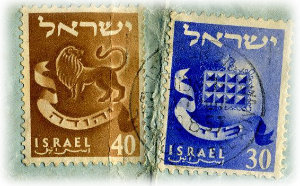
Letter Excerpts:
“It thrilled me to no end flying over Tel Aviv and landing”
— July 21, 1957
“Tel Aviv is beautiful and crowded light all hours of the night. New municipal pools all over and I made use of a nice one near the sea.
— July 26, 1957

Chamber of the Holocaust on Mt. Zion
Opposition leader, Menachem Begin leads the popular protests against Reparations
A mass protest in Israel against accepting Reparations (“Jewish blood money”) from Germany
When flying to Israel, the first thing ones sees as the plane descends for landing is the Mediterranean coast and the city of Tel-Aviv. The thrill of this view continues to be an emotional experience for first-time visitors and anyone returning to the Jewish homeland.
Tel Aviv
Tel Aviv, founded in 1909, is Israel’s second largest city and its biggest commercial center. It was the first Hebrew city to be built in modern times. While Tel Aviv today is similar to a Manhattan in the Middle East, this was not the case during the 1950’s. During that time Manhattan was well developed and distinguished by numerous tall buildings and many modern supermarkets. Tel Aviv, on the other hand, had lots of open, undeveloped areas, no tall buildings and no supermarkets. In general, city life was one of simplicity.
Food Shopping in Tel Aviv throughout the Decades
In the 50’s, food choices were limited both in restaurants and in local stores. Most Israeli consumers bought their groceries from the local “makolet” – mom and pop stores. The open air Carmel Market (Shuk HaCarmel) established in the 1920’s was the other alternative and continues until today to be a popular shopping venue for Israelis and tourists alike.
In 1958, the first Israeli supermarket, “Shufra Sal”, opened on Ben Yehuda Street in Tel Aviv. The first Israeli shopping mall, “Dizengoff Center”, opened in Tel Aviv in 1977, eclipses the historic “Dizengoff Square” which was built in 1934. In 1965, the Shalom Tower was completed. It was Israel’s first skyscraper, and the tallest building in the whole Middle East. Since then, ,many high-rise buildings were added to the Tel-Aviv skyline.
On the other hand, society was in the initial stages of exposure to Americanization and was developing trends and a character of its own. This was the pinnacle of the “kibbutz galuyot” period (the ingathering of the exiles), and the country was blending values of its varied populations from around the world. The influx of immigrants from both North Africa and Eastern Europe made for quite a mix.
Tel Aviv nightlife in the 1950’s was quite different than it is today. Young Israelis would listen and dance to western music, or get together for folk dancing. They also got together to discuss new books and songs in reading groups, as prose and poetry played an important part in their leisure.
Today, Tel Aviv is a vital busy metropolis known as the city that never sleeps, attracting visitors from all over the world with exciting nightlife and beaches.
The Tel Aviv skyline changed significantly when the
Disengoff Square, a center point of Tel-Aviv
in the late 1950’s.
Jerusalem’s First Holocaust Museum
Tucked away on the slope of Mount Zion near David’s Tomb adjacent to the Old City stands the Hall of Destruction, also known as the Chamber of the Holocaust.
The outside roof of the “Hall of Destruction”, also know as the “Chamber of the Holocaust”- from Bob Jacobs’ 1957 photos
The museum was created in 1949 (prior to Yad Vashem) by thirteen Holocaust survivors who came to Israel following the Holocaust and felt a need to memorialize their loved ones who perished. The Chamber showcases unique items that are not found in Yad Vashem. For instance, on display is a jacket sewn from a Torah scroll which a Nazi officer ordered a Jewish tailor to make.
A Nazi officer forced a Jewish tailor to sew him a shirt using a Torah scroll
German Compensation
Speaking of German reparations, the August 26, 1957 letter parenthetically mentions, that the train being traveled on was “built with German reparations”. Following the establishment of the Jewish State in 1948, the Germans offered the government of Israel reparations (compensation) as an apology for the Holocaust they perpetrated on the Jewish People. This German-made train is an example of that. But many Holocaust survivors were bothered by riding on these trains – it gave them the eerie reminder of being transported to the death camps.
Train manufactured by the German company, Maschinenfabrik Esslingen
in the old Jerusalem railway station, aquired as part of the reparations agreement with Germany, 1956
Trauma & Protest
The very concept of reparations and negotiations with Germany was unacceptable to a considerable portion of the Israeli public and sparked strong public controversy. Germany was the “land of the murderers” and funds from Germany was considered “blood money”.
Led by opposition leader Menachem Begin, mass protests calling for a boycott of Germany were organized. Begin stated that the reparations were a way easing Germany’s conscience, wiping clean the genocide they committed. Besides, he claimed, such payments did not reflect on the true amount of the looted and stolen items from the Jewish People in Europe. The battle regarding the reparations became a violent demonstration, during which protesters clashed with police and threw stones at the Knesset, shattering the windows of the building.
David’s possible changes and links
Review Aug 12 Holocaust memorials and Aug 26 German Reparations
In the book we put Chamber of Holocaust and German repaations on one page to fit. Some of the graphic were lost, especially the “pajamas”.
Should Holocaust Remembrance and Reparations be put on separate pages right next to each other?
1952 | Begin opposes the Reparations Program https://www.youtube.com/watch?v=fMWuS5_-M2c&t=5s
Following the defeat of the Herut Party in the elections for the Second Knesset, receiving only eight seats, Begin announced his resignation as head of Herut. However, his friend, Yochanan Bader, did not present his resignation to the Knesset Foreman. After a month-long leave in Europe, Begin began to contact lawyers to prepare for obtaining a license practice law. A few months later it was revealed that the government, led by David Ben-Gurion, intends to sign an agreement toward getting reparations from Germany. Begin, who objected strongly, decided to return to the political arena and lead the movement to fight against the reparations.
The idea of receiving reparations sparked strong public controversy. The government asked the Knesset to approve its power to negotiate with the German government for providing reparations to Israel. Begin attacked the upcoming agreement due to problematic phrasing – the agreement was presented as a kind of a way to correct and wipe clean the genocide committed by the Germans – and because the payments did not reflected on the true amount of the looted and stolen items from the Jewish people in Europe.
On January 7th, a debate took place at the Knesset, which was then located on King George Street in Jerusalem. Before the hearings started, Begin gave a heated speech at a mass rally in Zion Square nearby, and then returned to the Knesset, where he was the target of repeated insults from Ben-Gurion. Begin retorted with harsh words of his own, and when he refused to retract them, he has been banned for three months from the plenum. The battle regarding the reparations became a violent demonstration, during which protesters clashed with police and threw stones at the Knesset, shattering the windows of the building.
The opposition to reparations among Israelis was rooted in their belief that it would be blood money, given that Jews were the ones who had endured such atrocities. Menachem Begin, future Israeli prime minister, was one of those who jointly opposed reparations with West Germany in 1951. His arguments against it are still worth noting today: “You want to erase what happened from the memory of mankind? Wipe out history? Wipe out memory?”