July 27, 1957 Sat night
Dear Mom, Dad & Alan,
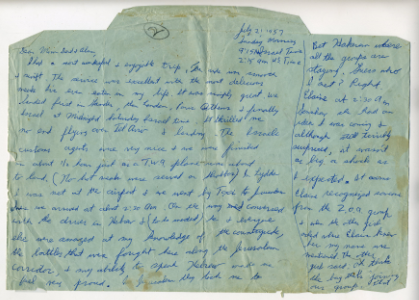
“Today was a most thrilling day. In Jerusalem ירושלים they say Birkat Kohanim ברכת כוהנים on every Shabbat.”
In the US, Jews of West European origin (Ashkenazim) only say “Birkat Kohanim” (blessing of the priests) on the High Holy days (Bob always loved to give his children, grandchildren and great grandchildren a “Birkat Kohanim” on Friday nights, festivals and other “smachot” (happy occasions)
“The Shabbas here (Jerusalem) was beautiful. Buses weren’t running and only a few cars moved to break the Shabbas”.
My father was referring to public buses not running on Shabbas. Some non public buses run on Shabbas especially in areas with non-Jewish populations.
“Today I got a real close up view of the old City. I even saw Arabs looking at us with machine guns and Spy Glasses.“
In 1948
“I am amazed at the extra friendly spirit of the Israelis; everyone we meet is willing to invite you to his home.”
Israel was a close-knit community during its early years, with people inviting strangers into their homes everyday of the week. Today, Israelis may be less hospitable, but a stranger is always welcome to join a Shabbas meal, especially in Jerusalem.
“I haven’t seen anyone wearing a suit, not even in the Israeli Parliament”
In 1957, the Israeli Knesset (Israel’s Parliament) was located at the “Beit Fruim building” on 26 King George Street, west Jerusalem. This is where my father visited with his ’57 group. Today this area is considered “the center of town”.
In 1966, the Knesset moved to Givat Ram, which is where it stands today. Interestingly, the current Knesset compound in Givat Ram in on land that was formerly known as Sheikh Badr before the 1948 Arab-Israeli War.
When David Ben Gurion officially declared the establishment of the State of Israel, he did so from Tel Aviv. At that time, Jerusalem was under siege and two of the thirteen members of Israel’s Provisional Government” who lived in Jerusalem were unable to attend. At first, members of the Israeli government (“Moetzet Ha’Am” – “ The People’s Council”) took up its residence in Tel Aviv. In 1949, it moved to Jerusalem, to the aforementioned King George location.
The name “Knesset” derives from the “Great Knesset” (Great Assembly) which convened in Jerusalem after the return of the Jews to Eretz Yisrael from the Babylonian exile in the fifth century. The number of 120 Knesset members was determined on the basis of the 120 members who sat in the Great Assembly. The first general elections was on January 25, 1949. Ben Gurion’s party (Mapai) received 46 Knesset seats and formed a coalition with other parties to form a government of 61 seats.