
August 3

— Spending Shabbat on Kibbutz
— Shabbat atmosphere felt even on a secular kibbutz
— On walk to Tzippori friendly Israelis offered grapes & drinks

Tzippori is a Jewish “moshav” located in the Jezreel Valley, in northern Israel, near Kibbutz Hasolaim

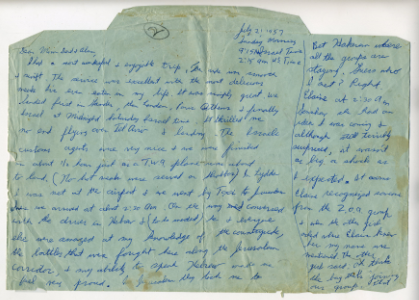
August 3, 1957 Saturday Night
Dear Mom, Dad and Alan,

Shabbas is now over & I’m going to the Kibbutz Social Hall to see a show.


Today I walked about 4 miles to a collective settlement called “Tzippori” Nearby was the ruins of an Arab Village which housed 14,000 families. The ruins of a shul was 2,000 years old was also visible & I walked through.

It really is something to be here on Shabbas and see the change from everyday life. On the way back we took a shortcut through beautiful country where acres & acres of wild edible fruits were growing. Everyone we passed invited you, gives you grapes, drinks etc, & in general is very friendly. Yet it still helps to speak Hebrew. It’s getting late & I want to see the show.


Missing You Love
Bob

Comments:

August 3, 1957 Saturday Night

“Today I walked to a collective settlement called Tzippori”
Tzippori is five kilometers away from Kibbutz Hasolelim, the place my father was staying. It is an area in the lower Galilee, the Jezreel Valley, surrounded by a large number of Arab villages. My father walked around freely, unconcerned for his physical safety. Tzipori has deep historical significance, and is still the site of one of Israel’s most interesting archaeological sites. In the day of the Romans, it was the capital of the Galilee, the seat of the Sanhedrin and the place where the oral law (Mishna) was compiled.

“Shabbat is now over and I’m going to the kibbutz social hall to see a show… It is really something to be here on Shabbat and see the change from everyday life”.
Even on an irreligious kibbutz, one was able to feel the Sabbath. Today, people from religious communities are invited by kibbutzim (including Degania – Israel’s first kibbutz) to pray with them on Yom Kippur. My son has participated in this program. They continue to be invited back every year. Kibbutzim that never had a synagogue are now building synagogues.

“Everyone we passed invited you, gives you grapes, drinks, etc, and in general are very friendly.”
In the 1950’s most Israelis were very hospitable to visiting foreigners.