July 31
— Kibbutz: Wonderful experience living & working together
— “Some of the highest acre yields in the world”
— Kibbutzniks described as “settlers”
In the 50’s kibbutzniks were known as “settlers,” They were expanding the country.
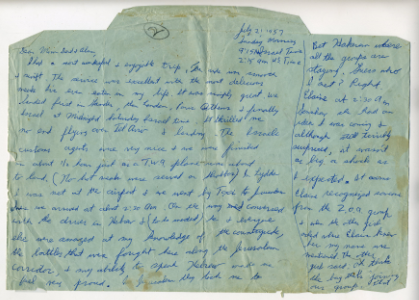
July 31, 1957 Wednesday Evening
Dear Mom, Dad and Alan,
I am still on the Kibbutz & will probably stay until Sunday, making it a week. It is a wonderful experience, both in people living together & working together. I was amazed to learn that this place is almost 3,000 acres in area & has some of the highest acre yields in the world in certain items, dependent of course on proper irrigation.
Tonight the boys played a basketball game against the settlers here and were defeated. An interesting thing to watch is the lack of endurance the Americans have compared to the Israelis, including those who arrived recently from Poland, North Africa, etc.
Time for Bed,
So……Love,
Bob
Comments:
July 31, 1957 Wednesday Evening
“I am still on the Kibbutz… It is a wonderful experience, both in people living together & working together.”
Back when Israel was established and through the 1950’s, the kibbutzim were loyal to both the country and to the socialist ideal of equality. The members of the kibbutz did what was best for both the country and the kibbutz. “Equality” was maintained, as monies made were shared by all members of the kibbutz. People ate meals together in a community dining room and children lived in a children’s center and not with their nuclear family. Doctors and lawyers who worked outside the kibbutz would give their salary to the kibbutz.
But over time this began to change. One of the first major disputes among kibbutz members in the mid-1950’s was the subject of Holocaust reparations. The Holocaust survivors residing in the kibbutz wanted the money to be distributed directly to them, and not shared with the kibbutz.
In time, other issues arose. The lawyers and doctors felt that they should be able to keep some of the money that they earned privately. Also plaguing the kibbutz was “proteccia”, or favoritism. Those who had better connections were favored over others. All these were serious problems, and most kibbutzim simply couldn’t continue to survive as a socialist society with full equality. In the end, each kibbutz solved their problems in their own way.
For instance, regarding the reparations, some kibbutzim used the money to build community pools and community centers, while others allowed the families of the Holocaust survivors to keep it.
Today many of the kibbutzim have turned to privatization, including Israel’s oldest kibbutz “Degania”. Indeed, many kibbutzim today are run as any other capitalist enterprise except many things are still shared.
“I am still on the kibbutz tonight. The (American) boys played a basketball game against the Settlers (Kibbutzniks) and were defeated by the Settlers.”
In 1957 the Kibbutzniks were known as “settlers” since they were the pioneers of that time. Ironically, today many left wing kibbutzniks consider the modern-day “settlers” of Judea-Samaria as the enemy.